A Saudi apartment viewing should not end at the front door. Before deciding whether a home fits your needs, ask how the entrance, lift, parking and other shared facilities are documented and managed. AqarLex recommends treating the apartment and the shared-building information as one review file, rather than making a decision from the interior photographs alone.
Saudi Arabia's Unit Ownership, Subdivision and Management Law includes entrances, corridors and lifts among common parts, and requires a seller's disclosure statement covering the unit and associated rights and obligations.[1] Its implementing regulation specifies information including the unit's common-parts share, association documents and decisions where applicable, use restrictions and known defects.[2] Those are the verified starting points for this buyer checklist, not a claim that every building has identical arrangements.
Start with a document request, not a verbal assurance
Ask the seller for the disclosure statement and the documents supporting the advertised apartment, then keep a dated copy of the package you receive. Create a simple index: unit identity, shared facilities, management, charges and unresolved questions. This index is an editorial recommendation, not a prescribed government form. Its purpose is to stop different answers becoming scattered across messages, photographs and attachments.
For each important statement, record the document, page and person who supplied it. If someone says that a parking space is exclusive, ask them to identify the supporting record instead of relying on a painted number. If a document is missing, mark the question unanswered. Avoid filling the gap with assumptions about how a neighbouring building operates.
Separate ownership, access and day-to-day use
On a viewing, ask three distinct questions about each shared feature: what does the documentation identify, who may use it, and how is its operation organised? Apply that distinction to a courtyard, roof area, storage room or vehicle entrance. A sales description such as "private access" should prompt a request for clarification, not your own conclusion about the legal nature of the space.
Use a short comparison sheet alongside the plans supplied for the property. Put the advertised claim in one column and the documentary explanation in another. Where the two differ, request a written explanation tied to the exact unit. This approach is particularly useful when marketing images show an amenity without explaining whether its use is restricted or how it is managed.
Ask how the building is managed
REGA describes Mullak as supporting relationships between owners and the management of common parts through electronic services; its page also identifies a service for viewing association subscription fees and payment arrangements.[3] Use that information as a route for further inquiry, not as proof that the particular building has complete records or that its management is effective.
Ask the seller or authorised association representative to explain the building's current arrangements. Who receives maintenance reports? Who can explain the latest decisions? Which contact should you use for an urgent lift problem? Request the relevant association documents and available decisions through an appropriate channel. Do not ask someone to share unrelated owners' personal information just to demonstrate that a group exists.
Review charges as a separate decision
The law provides for owners to contribute to common-parts maintenance and management costs in proportion to their unit area, with potentially different contributions for different uses in mixed-use property.[1] For a specific purchase, ask for the applicable calculation and its documentary basis rather than applying an assumed flat charge to every apartment.
For your own comparison, request the stated payment period, services covered, approval record and explanation of any proposed additional works. Separate an approved amount from a draft budget or a salesperson's estimate. Ask whether the information supplied includes unresolved amounts associated with the unit, and refer any uncertainty about responsibility to a qualified adviser before committing. This guide supplies no building-specific charge or legal allocation of a seller's outstanding balance.
Inspect the shared facilities as well as the rooms
AqarLex recommends a second walk focused only on the building's common areas. Observe the route from the street to the apartment, the lift lobby and the facilities you expect to use. Note the date, location and question raised by anything you see. Describe an observation precisely: "water mark beside lobby ceiling" is more useful than an unsupported diagnosis of a structural defect.
Ask for a qualified technical assessment where an issue could affect safety, structure or a significant repair decision. Request clarification about planned works and available maintenance information, while distinguishing a service log from a professional condition assessment. Do not treat an attractive lobby, a clean corridor or a single visit as evidence that all hidden systems are sound.
Keep unresolved items visible before signing
Build a final question list with three statuses: answered with a document, awaiting clarification, or requiring professional advice. Include the exact unit reference and date of each answer. If a reply changes the earlier explanation, keep both versions and ask which record should govern your understanding. Avoid letting an unresolved facility or charge disappear merely because the interior inspection went well.
A useful decision file does not have to be elaborate. It should let you explain what you are buying, which shared facilities you expect to use, what management information you reviewed and which questions remain open. If those points cannot be reconciled, consider pausing for clarification or specialist advice rather than treating urgency as a substitute for evidence.
Scope and source date
This is an editorial due-diligence guide, not a property valuation, technical certificate or legal opinion. The official law, implementing regulation and Mullak service page were reviewed on 26 October 2026.[1][2][3] They are existing references, not an announcement of a new launch. The practical workflow above is AqarLex's recommendation and does not promise a transaction outcome, a fixed fee or automatic entitlement in a dispute.
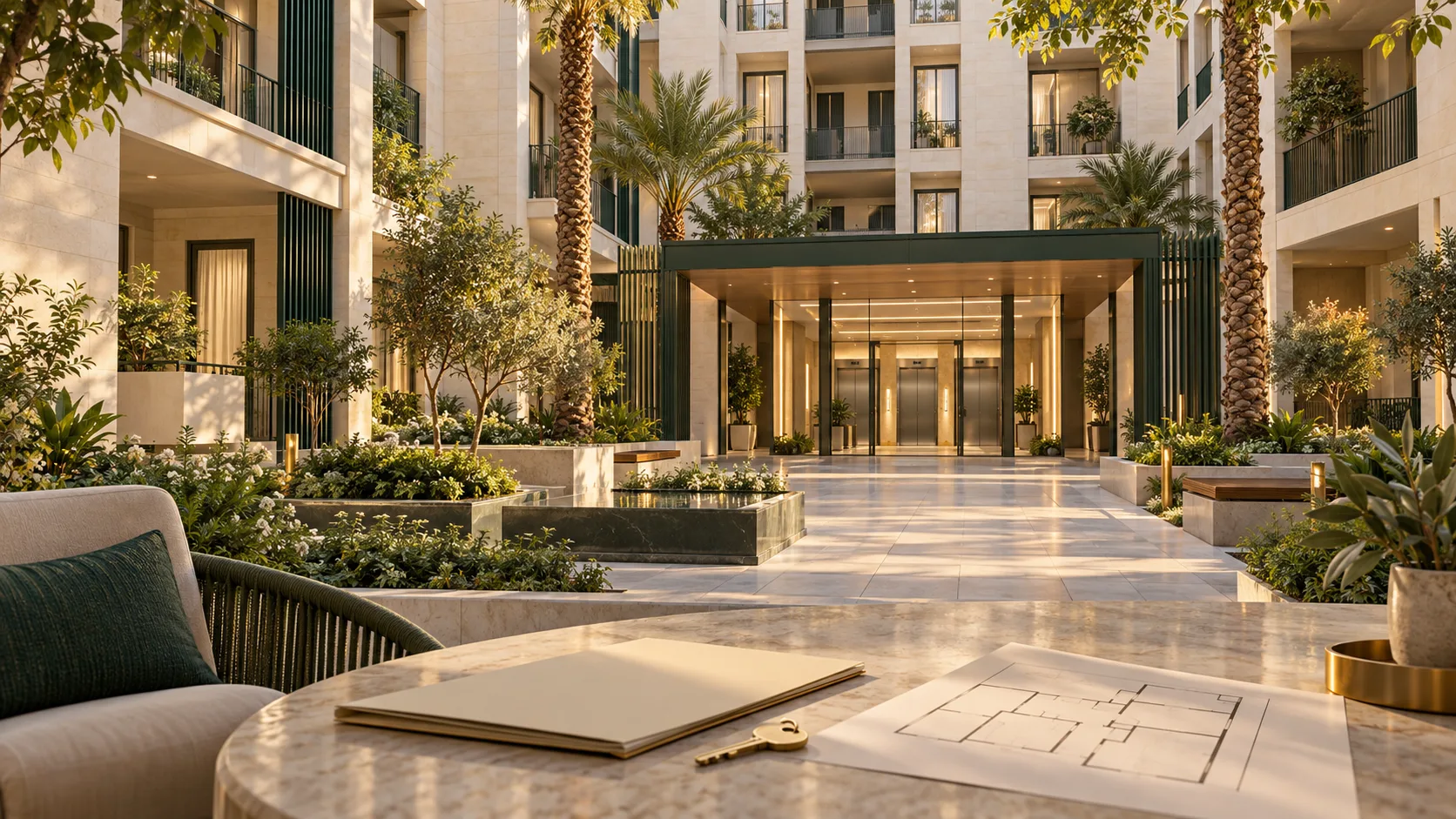
Hero image: AI-generated conceptual illustration of a residential courtyard and shared entrance; it does not depict an identified property or an official plan.
Sources
[1] https://rega.gov.sa/%D8%A7%D9%84%D8%A3%D9%86%D8%B8%D9%85%D8%A9-%D9%88%D8%A7%D9%84%D9%82%D8%B1%D8%A7%D8%B1%D8%A7%D8%AA/%D8%A7%D9%84%D8%A3%D9%86%D8%B8%D9%85%D8%A9-%D9%88%D8%A7%D9%84%D9%84%D9%88%D8%A7%D8%A6%D8%AD-%D9%88%D8%A7%D9%84%D8%A3%D8%AF%D9%84%D8%A9/%D8%A7%D9%84%D8%A3%D9%86%D8%B8%D9%85%D8%A9/%D9%86%D8%B8%D8%A7%D9%85-%D9%85%D9%84%D9%83%D9%8A%D8%A9-%D8%A7%D9%84%D9%88%D8%AD%D8%AF%D8%A7%D8%AA-%D8%A7%D9%84%D8%B9%D9%82%D8%A7%D8%B1%D9%8A%D8%A9-%D9%88%D9%81%D8%B1%D8%B2%D9%87%D8%A7-%D9%88%D8%A5%D8%AF%D8%A7%D8%B1%D8%AA%D9%87%D8%A7 — نظام ملكية الوحدات العقارية وفرزها وإدارتها [2] https://rega.gov.sa/%D8%A7%D9%84%D8%A3%D9%86%D8%B8%D9%85%D8%A9-%D9%88%D8%A7%D9%84%D9%82%D8%B1%D8%A7%D8%B1%D8%A7%D8%AA/%D8%A7%D9%84%D8%A3%D9%86%D8%B8%D9%85%D8%A9-%D9%88%D8%A7%D9%84%D9%84%D9%88%D8%A7%D8%A6%D8%AD-%D9%88%D8%A7%D9%84%D8%A3%D8%AF%D9%84%D8%A9/%D8%A7%D9%84%D9%84%D9%88%D8%A7%D8%A6%D8%AD/%D8%A7%D9%84%D9%84%D8%A7%D8%A6%D8%AD%D8%A9-%D8%A7%D9%84%D8%AA%D9%86%D9%81%D9%8A%D8%B0%D9%8A%D8%A9-%D9%84%D9%86%D8%B8%D8%A7%D9%85-%D9%85%D9%84%D9%83%D9%8A%D8%A9-%D8%A7%D9%84%D9%88%D8%AD%D8%AF%D8%A7%D8%AA-%D8%A7%D9%84%D8%B9%D9%82%D8%A7%D8%B1%D9%8A%D8%A9-%D9%88%D9%81%D8%B1%D8%B2%D9%87%D8%A7-%D9%88%D8%A5%D8%AF%D8%A7%D8%B1%D8%AA%D9%87%D8%A7 — اللائحة التنفيذية لنظام ملكية الوحدات العقارية وفرزها وإدارتها [3] https://rega.gov.sa/rega-services/platforms/mullak — جمعيات المُلاَّك
Contact AqarLex