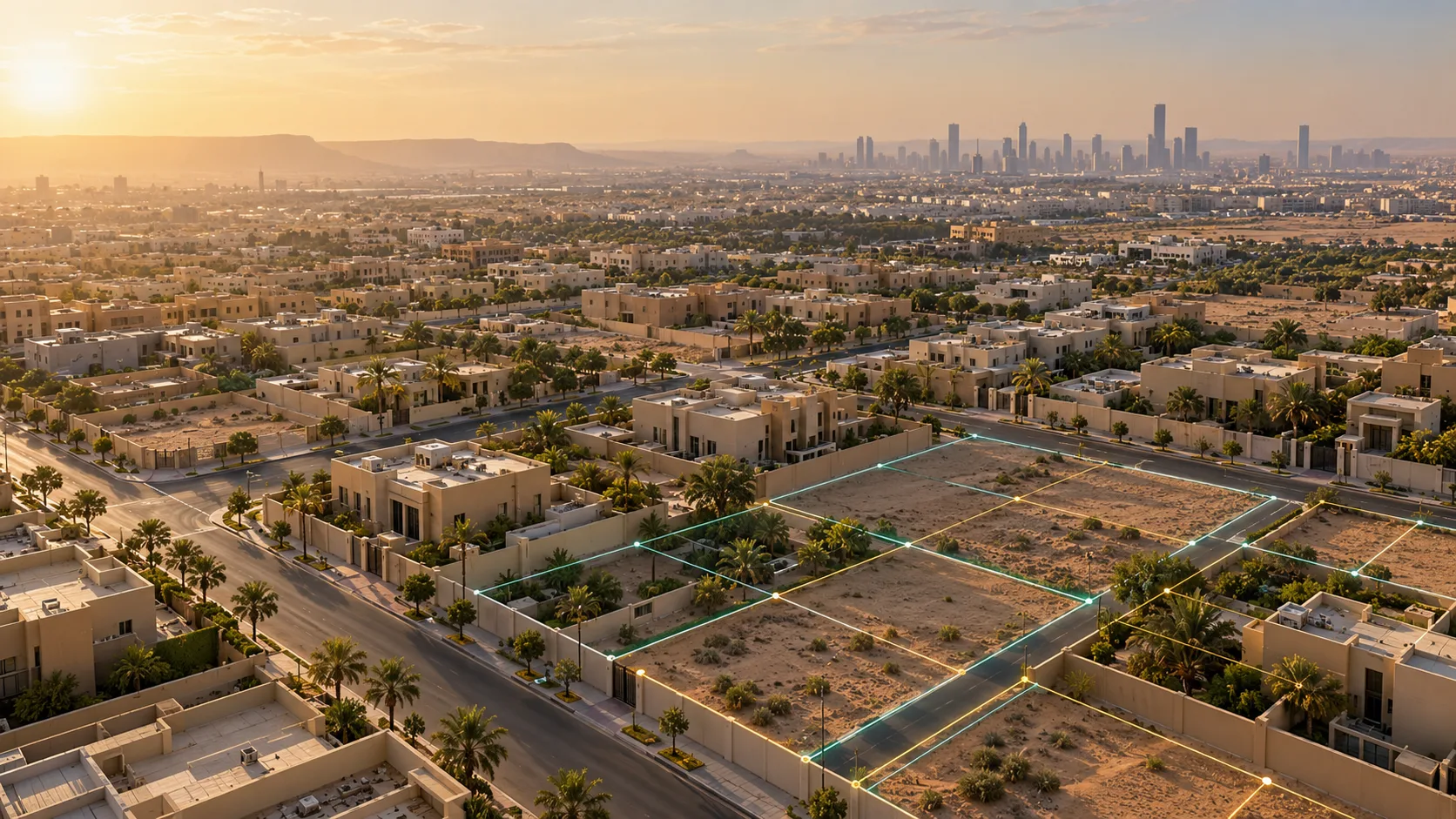
Saudi Arabia’s Real Estate General Authority (REGA) has announced a new first-registration phase covering 28,547 property parcels in the Riyadh region. Published on 21 October 2026, the announcement sets the registration window from Sunday, 25 October 2026, through the end of Thursday, 28 January 2027.[3]
For owners, the immediate question is whether their particular property falls inside the announced boundaries. For buyers, the useful question is what the seller can show about the property’s registration position. Neither question is answered by a neighbourhood name in an advertisement.
This guide separates the verified announcement from AqarLex’s practical recommendations. It is an owner-readiness and due-diligence checklist, not a prediction about prices or a substitute for advice on an individual title.
Riyadh region is not the same as every property in Riyadh
The announcement identifies selected areas across the Riyadh region, including parts of open areas associated with the Al-Aziziyah, Al-Ha’ir and Al-Sulay municipalities in Riyadh city, alongside named neighbourhoods and individual parcels in other towns and centres.[3]
Do not read a regional headline as confirmation that every property within the capital is included. A useful starting point is the Real Estate Registry’s announced-areas section, which is available from its official website.[6]
As a practical check, match the property’s location and identifiers against the official boundary information. If the result is unclear, ask the registry to clarify the particular parcel rather than relying on a nearby landmark or a broker’s recollection. Keep the response with the property file so that everyone reviewing the transaction works from the same information.
What first registration records
REGA describes registration as a property-centred system: the unit is the basis for recording ownership, associated rights and subsequent transactions. Its explanation distinguishes between the ownership registration deed and the property register sheet, which also records changes over time.[2]
That distinction matters when reviewing paperwork. A property description, a record of ownership and a chronological record of changes answer different questions. Ask which document you have been given and what it establishes, rather than treating every official-looking page as interchangeable.
For a prospective purchase, organise questions around the property itself: which unit is being sold, how its area and location are described, and what documents support the seller’s explanation. Where information conflicts, record the discrepancy explicitly and obtain clarification before treating the file as complete.
Prepare the title and the applicant’s authority
REGA’s published first-registration requirements include a valid national identity or residency document for individuals, an updated electronic title issued by the Ministry of Justice, and a property located within an announced area. Its guidance also specifies documentation for private entities and a valid power of attorney where an agent submits the application.[2]
Start with a document review, not a last-minute upload. Check that names and identifiers are consistent across the material you intend to submit. If a company owns the property, identify who will act for it and ask which corporate authorisation documents apply. If an agent will submit, confirm the required scope of the power of attorney through the official guidance.
These are preparation recommendations, not an exhaustive eligibility assessment. A shared, inherited or otherwise complex ownership situation deserves a case-specific question to the registry or an appropriately qualified adviser. Do not assume that a document accepted for another property resolves your own file.
Use the official route and keep the evidence
The Registry website offers first registration for properties in announced areas and provides access to its electronic services. It also lists subsequent services such as ownership transfer and management of rights, restrictions and obligations for registered properties.[6]
REGA’s property-inquiry page separately describes a service for checking details such as ownership, location and area.[5]
Use those official entry points rather than sending identity documents through an unsolicited message. Keep a dated record of your application, the reference provided and any requests for additional information. If the portal asks for a correction, preserve both the original issue and the response rather than replacing the file with an unexplained final screenshot.
For buyers, request relevant evidence through the seller or their authorised representative. A readable screenshot can help a discussion, but the better objective is a traceable document trail that can be checked through the appropriate official channel.
A practical sequence for owners before opening day
With the announced opening still ahead as of 23 October 2026, preparation can be organised into a short workflow.[3]
- Identify the parcel. Put the title reference, location information and any existing property identifiers in one file.
- Confirm inclusion. Check the official announced-area information and seek clarification if the boundary is ambiguous.
- Review the applicant. Decide whether the owner, a company representative or an agent will submit, then check the applicable documentation.
- Resolve inconsistencies. List mismatched names, unclear descriptions or missing documents and ask how they should be addressed.
- Track progress. Assign responsibility for checking official responses and retaining the application record.
For an owner with several properties, repeat the location check for each parcel. A shared city name is not a useful substitute for a property-by-property readiness list.
What buyers and investors should not infer
AqarLex’s assessment is that this announcement is a reason to improve documentation, not a standalone investment signal. The parcel count describes the scope of the registration phase; it should not be presented as a count of homes offered for sale, completed applications or new housing supply.
Likewise, do not build a price forecast from the registration timetable. Anyone assessing a purchase should separately examine the property’s condition, intended use, financing assumptions and transaction-specific documents. A well-organised registry file answers documentation questions; it does not replace the rest of a purchase review.
If completion of registration is important to a proposed transaction, ask a qualified adviser how the agreement should address timing, outstanding information and responsibilities. Avoid relying on a verbal promise that every administrative step will finish before a particular payment date.
Where to clarify a difficult case
REGA’s announcement directs owners to official channels and gives 199002 as the customer-service number for questions about registration steps.[3]
Prepare a concise question before contacting support: identify the parcel, explain the unclear point and distinguish a boundary question from a document or applicant-authority question. This makes the answer easier to use and reduces the risk of applying general guidance to a different issue.
The priority is straightforward: establish whether the property is included, assemble the correct documents and maintain a verifiable record. For the new Riyadh-region phase, those checks are more useful than treating a regional registration headline as a promise about an individual asset.
Information checked on 23 October 2026. Practical recommendations are AqarLex editorial analysis; official requirements should be confirmed for the individual case.
Sources
[2] https://rega.gov.sa/rega-services/platforms/real-estate-registry — REGA: Real Estate Registry programme and first-registration FAQs (undated guidance) [3] https://rega.gov.sa/media-center/%D8%A7%D9%84%D8%A3%D8%AE%D8%A8%D8%A7%D8%B1-%D9%88%D8%A7%D9%84%D8%A5%D8%B9%D9%84%D8%A7%D9%86%D8%A7%D8%AA/%D8%A8%D8%AF%D8%A1-%D8%A3%D8%B9%D9%85%D8%A7%D9%84-%D8%A7%D9%84%D8%B3%D8%AC%D9%84-%D8%A7%D9%84%D8%B9%D9%82%D8%A7%D8%B1%D9%8A-%D9%84%D9%80-28547-%D9%82%D8%B7%D8%B9%D8%A9-%D8%B9%D9%82%D8%A7%D8%B1%D9%8A%D8%A9-%D9%81%D9%8A-%D9%85%D9%86%D8%B7%D9%82%D8%A9-%D8%A7%D9%84%D8%B1%D9%8A%D8%A7%D8%B6 — REGA: Riyadh-region first-registration announcement, published 21 October 2026 [5] https://rega.gov.sa/rega-services/real-estate-inquiries/%D8%A7%D8%B3%D8%AA%D8%B9%D9%84%D8%A7%D9%85-%D8%B9%D9%86-%D8%B9%D9%82%D8%A7%D8%B1 — REGA: Property inquiry service (undated service page) [6] https://rer.sa — Real Estate Registry: official portal, services and announced areas (undated)
Contact AqarLex